Beyond the Machines: Learning the Language of Strength
Walk into any gym and you’ll see a curious split. On one side, rows of gleaming, complex machines with detailed pictograms. They’re inviting, like workout vending machines: insert your effort, get a result. On the other side lies a more rugged landscape: barbells loaded with plates, racks of dumbbells, and simple, intimidating benches.Foundation
Most beginners, understandably, gravitate to the machines. They feel safer, more guided. But while machines have their place, they teach your body to function in isolation, in a single, fixed path. To truly build a strong, balanced, and resilient physique, you need to learn the foundational movements, not just use the gadgets.Foundation You need to learn the language of strength, and that language is spoken with free weights and your own body.Foundation
This article isn’t a list of 50 confusing exercises. It’s a focused blueprint on the essential, beginner-friendly exercises for muscle gain. We’ll prioritize movements over muscles, master a handful of powerful patterns, and build a framework that will serve you for a lifetime of training. Forget the fluff. We’re here to build a foundation, brick by solid brick.
Part 1: The Philosophy – Movement Patterns, Not “Muscle Days”
The biggest mistake a beginner can make is thinking in terms of “chest day” or “arm day.” Your body doesn’t work in isolated segments; it works in integrated patterns. Master these patterns, and you build a functional, proportionate physique.Foundation
For muscle gain (hypertrophy), we focus on five fundamental human movement patterns. Every exercise we choose will fall into one of these categories. This ensures we build a balanced body and reduce injury risk.Foundation
- The Squat: The king of lower body movements. It’s sitting down and standing up, loaded. It builds your quads, glutes, hamstrings, and core.
- The Hinge: The powerhouse of the posterior chain (the back of your body). It’s bending at the hips, not the back. This builds your hamstrings, glutes, and lower back like nothing else.Foundation
- The Push: Moving weight away from your torso. We split this into Horizontal Pushes (like push-ups) for chest, and Vertical Pushes (like overhead press) for shoulders.
- The Pull: Moving weight toward your torso. Again, Horizontal Pulls (like rows) for back thickness and Vertical Pulls (like pull-ups) for back width.
- The Carry: This is the unsung hero. Simply picking up heavy things and walking. It builds monstrous core stability, grip strength, and shoulder health.Foundation
Your beginner program will be built by choosing one or two key exercises from each of these patterns. It’s that simple, and that effective.
Part 2: The Exercise Library – Your Foundational Toolkit
Let’s break down the best beginner-friendly exercises for each pattern. We’ll start with the most accessible version and show you how to progress.Foundation
Pattern 1: The Squat
1. Goblet Squat: The Perfect Teacher
- Why it’s beginner-friendly: Holding a dumbbell or kettlebell in front of your chest acts as a counterbalance. This naturally helps you keep your torso upright, teaches you to sink your hips back and down, and makes it easier to hit proper depth (thighs parallel to the floor or below).Foundation
- How to do it:
- Hold one dumbbell vertically against your chest, cupping the top end with both hands.
- Stand with feet shoulder-width apart, toes slightly turned out.
- Take a deep breath into your belly, brace your core (like you’re about to be punched).
- Initiate the movement by pushing your hips back as if aiming for a chair behind you, then bend your knees.
- Lower yourself down, keeping your chest up and back straight, until your elbows touch the inside of your knees (or as low as mobility allows).
- Drive through your whole foot to stand back up, squeezing your glutes at the top.Foundation
- Progression: Start with bodyweight, then a light dumbbell (15-25 lbs). Gradually increase the weight as you master the form.
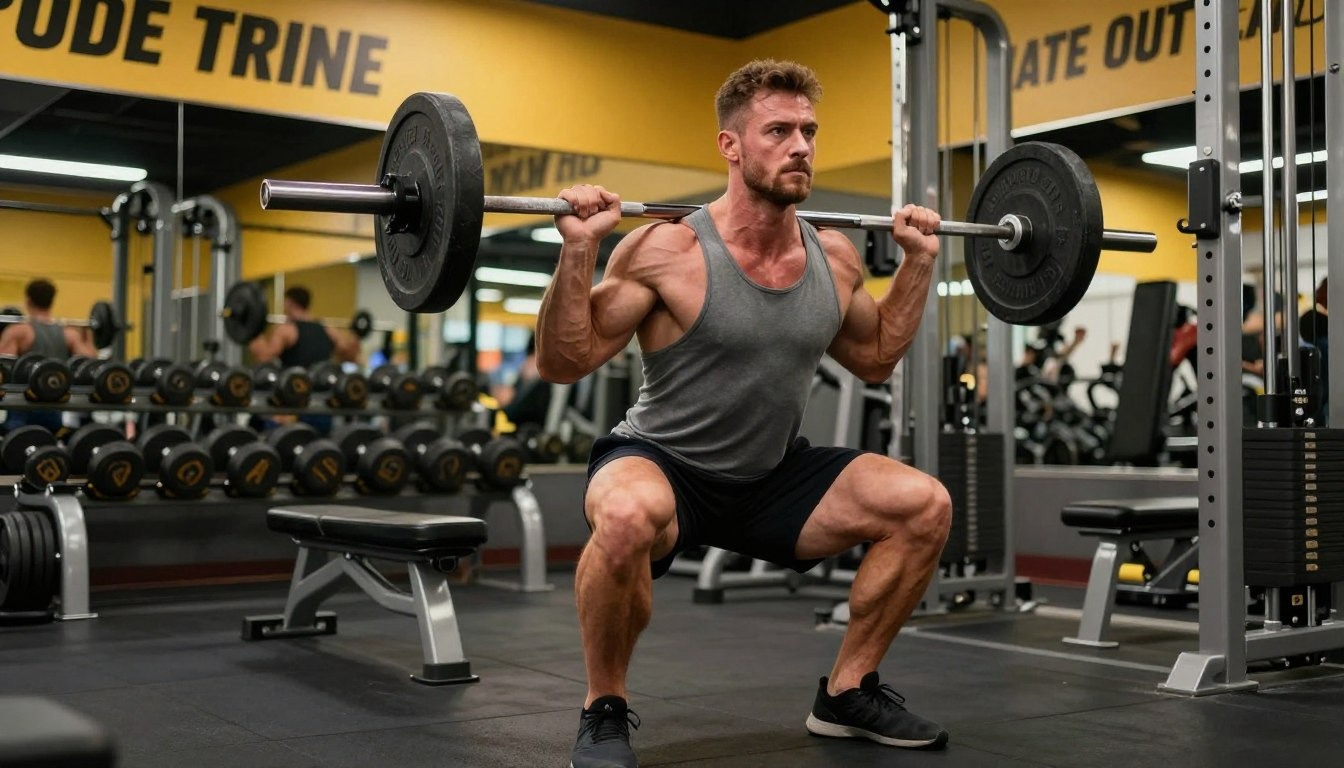
2. Barbell Back Squat: The Ultimate Builder
- Why it’s the goal: Once you’re comfortable with the Goblet Squat, the barbell back squat is the most effective mass-builder for your entire lower body. It allows you to safely load significant weight.Foundation
- Beginner Setup Key: Use the safety racks. Always. Set them just below the depth of your squat.
- Step under the bar, resting it on your upper back/traps (not your neck). Squeeze your shoulder blades together to create a “shelf.”
- Unrack the bar, take two small steps back.
- Execute the same movement pattern as the goblet squat: brace, hips back, descend with control, drive up.Foundation
- Crucial Tip: Don’t ego-lift. Start with just the 45lb barbell. Film yourself from the side to check depth and back position.
Pattern 2: The Hinge
1. Romanian Deadlift (RDL) with Dumbbells: The Hinge Masterclass
- Why it’s beginner-friendly: The RDL teaches the pure hip hinge, minimizing knee bend and maximizing hamstring and glute stretch. Dumbbells are easier to manage than a barbell initially.Foundation
- How to do it:
- Hold two dumbbells in front of your thighs, standing tall.
- Take a breath and brace your core.
- With a micro-bend in your knees (do not squat!), push your hips straight back. The dumbbells will slide down your thighs.
- Keep your back perfectly straight, from your neck to your tailbone. You should feel a deep stretch in your hamstrings.Foundation
- Lower until you feel a strong stretch or your back starts to round—then stop.
- Squeeze your glutes HARD to pull your hips forward and return to standing. Think of pushing the ground away with your feet.
- Feel over Weight: This is about the stretch and contraction, not moving max weight. A 30lb dumbbell in each hand is plenty to start.Foundation
2. Hip Thrust: The Glute Specialist
- Why it’s beginner-friendly: It isolates the glutes effectively and is very safe for the back. It’s also a fantastic way to learn posterior chain activation.
- How to do it:
- Sit on the ground with your upper back against a stable bench. Roll a barbell over your hips (use a pad!) or use a single heavy dumbbell.
- Plant your feet flat, about hip-width apart.Foundation
- Drive through your heels to lift your hips up until your body forms a straight line from shoulders to knees.Foundation
- Squeeze your glutes at the top for a full second, then lower with control.
Pattern 3: The Push
Horizontal Push: The Dumbbell Bench Press
- Why it’s better than barbell for beginners: Dumbbells allow for a more natural range of motion, require more stabilizer muscle engagement, and are safer—you can’t get pinned under them. They also help correct imbalances between sides.
- How to do it:
- Sit on a flat bench with a dumbbell on each knee. Lie back, using your knees to help “kick” the weights into position.
- Hold the dumbbells at chest level, palms forward, elbows at about a 45-degree angle to your body (not flared straight out).
- Press the weights up in a slight arc until they meet over the middle of your chest.
- Lower with control, feeling a stretch in your chest. Stop when your elbows are just below your shoulders.
Vertical Push: The Dumbbell Overhead Press
- Why it’s essential: Builds strong, healthy shoulders and triceps, and develops core stability.
- How to do it:
- Hold two dumbbells at shoulder height, palms facing forward, elbows in front of the weights.
- Brace your core and glutes tightly—imagine you’re squeezing a penny between your butt cheeks. This stabilizes your spine.
- Press the weights directly upward, brushing past your face, until your arms are fully extended overhead.
- Lower with control back to the start position.
Pattern 4: The Pull
Horizontal Pull: The Bent-Over Dumbbell Row
- Why it’s a cornerstone: Builds thickness in your upper and middle back, crucial for posture and balanced pushing strength.
- How to do it:
- Hold two dumbbells, hinge at your hips (like an RDL), and lower your torso until it’s nearly parallel to the floor. Let the weights hang. Keep your back straight!
- Squeeze your shoulder blades together and row the dumbbells up to your ribcage. Your elbows should drive back, not out.
- Squeeze hard at the top, then lower with control. Avoid using momentum—this is about the muscle, not the swing.
Vertical Pull: The Lat Pulldown Machine
- Why it’s the beginner gateway: Until you can do a pull-up, the lat pulldown is your best friend for building the wide “V-taper” back.
- How to do it CORRECTLY (most people do it wrong):
- Sit down, adjust the thigh pads so you’re secure.
- Grab the bar with a wide, overhand grip.
- Lean back slightly (about 30 degrees) from the waist. This is key.
- Pull the bar down to your upper chest, driving your elbows down and back. Imagine you’re trying to squeeze a pencil between your shoulder blades.
- Resist as you let the bar go back up, feeling a stretch in your lats. Do not just let it yank you up.
Pattern 5: The Carry & Core
The Farmer’s Walk: Simplicity Meets Brutal Effectiveness
- Why it’s magical: It builds grip strength, traps, forearms, and a rock-solid core that braces under load. It’s functional strength personified.
- How to do it:
- Pick up two heavy-ish dumbbells or kettlebells (start with what you can hold for 30 seconds).
- Stand tall, shoulders back, core braced.
- Walk slowly and deliberately for a set distance (e.g., 40 feet) or time (30 seconds). Focus on not letting your torso wobble.
Core: The Plank (It’s Not What You Think)
- Forget endless minute-long holds. The goal is maximal tension.
- How to do it right:
- Get into a push-up position on your forearms.
- Screw your hands into the floor, squeeze your glutes as hard as you can, and brace your abs like you’re about to be punched.
- Hold this full-body tension for 15-20 seconds. If you can hold longer with perfect tension, you’re not bracing hard enough. Quality over duration.
Part 3: Building Your First Simple & Powerful Program
Now, let’s assemble these tools into a plan. For a beginner, full-body workouts performed 3 times per week (e.g., Monday, Wednesday, Friday) are ideal. This maximizes frequency and learning.
Sample Full-Body Workout A:
- Goblet Squat: 3 sets of 8-10 reps
- Dumbbell Bench Press: 3 sets of 8-10 reps
- Bent-Over Dumbbell Row: 3 sets of 8-10 reps
- Plank: 3 sets of 15-20 second holds
Sample Full-Body Workout B:
- Romanian Deadlift (Dumbbells): 3 sets of 10-12 reps
- Dumbbell Overhead Press: 3 sets of 8-10 reps
- Lat Pulldown: 3 sets of 8-10 reps
- Farmer’s Walk: 2 walks of 30-40 feet.
How to Progress: Follow this ABX ABX pattern (where X is a rest day). So: Week 1: A, B, A. Week 2: B, A, B.
The Golden Rule of Progression: Each week, try to do a little more. This is called Progressive Overload, the engine of muscle growth.
- Can you add one more rep to one or more sets?
- Can you add one more set?
- Finally, can you add the smallest amount of weight possible (5 lbs total)?
Part 4: The Non-Negotiables – Form, Mindset, and Patience
1. Form Before Everything
Muscle grows from tension in the target muscle, not from moving weight with momentum and poor form. A perfect rep with a lighter weight is worth ten sloppy reps with a heavy one. If you have to swing to curl a dumbbell, it’s too heavy. Prioritize the feeling in the muscle.
2. The Mind-Muscle Connection
Don’t just go through the motions. Think about the muscle you’re trying to work. On a row, visualize your back muscles contracting to pull the weight. On a squat, feel your glutes driving you up. This focused intention can significantly increase muscle activation.
3. Embrace the Learning Curve
Your first few weeks are about skill acquisition, not transformation. Celebrate learning a new movement correctly. The strength and size will come as a direct result of mastering these skills.
4. You Don’t Need to Be Sore to Have Grown
Delayed Onset Muscle Soreness (DOMS) is not a badge of honor. It’s just novelty. As you get consistent, soreness will lessen. Don’t chase it with reckless workouts. Consistent, progressive effort is the true driver.
5. Simplicity is Strength
The fitness industry profits from complexity. It makes you feel like you need a secret, convoluted routine. You don’t. The exercises outlined here, performed consistently with progressive overload for 6-12 months, will produce better results than 90% of the complicated programs out there.
Conclusion: Building Your Basecamp
Starting your muscle-building journey can feel like standing at the base of a mountain. The secret isn’t to sprint up the first slope; it’s to build a sturdy basecamp right where you are.
These beginner-friendly exercises are the tools to build that basecamp. They are not exotic or flashy, but they are time-tested, scientifically sound, and profoundly effective. They teach your body to move as a coordinated, powerful unit. They build strength that translates to real life. And they create a symmetrical, athletic physique.
Master the squat, hinge, push, pull, and carry. Adhere to the simple full-body program. Prioritize form over ego. Add weight slowly, like a patient craftsman.
The journey of adding muscle is a marathon of consistent, smart effort. You now have the map and the first, most important set of tools. The foundation is yours to build. Now, go pick up the first brick.
Focus Keywords: Beginner Gym Exercises, Muscle Gain for Beginners, Foundational Lifts
SEO & Article Keywords: best exercises for beginners, how to start lifting weights, simple muscle building workout, full body routine for beginners, goblet squat tutorial, dumbbell exercises, how to deadlift safely, learn to bench press, back exercises for beginners, progressive overload explained, gym workout for newbies, compound exercises, building a strength foundation, at-home muscle building, functional training basics.