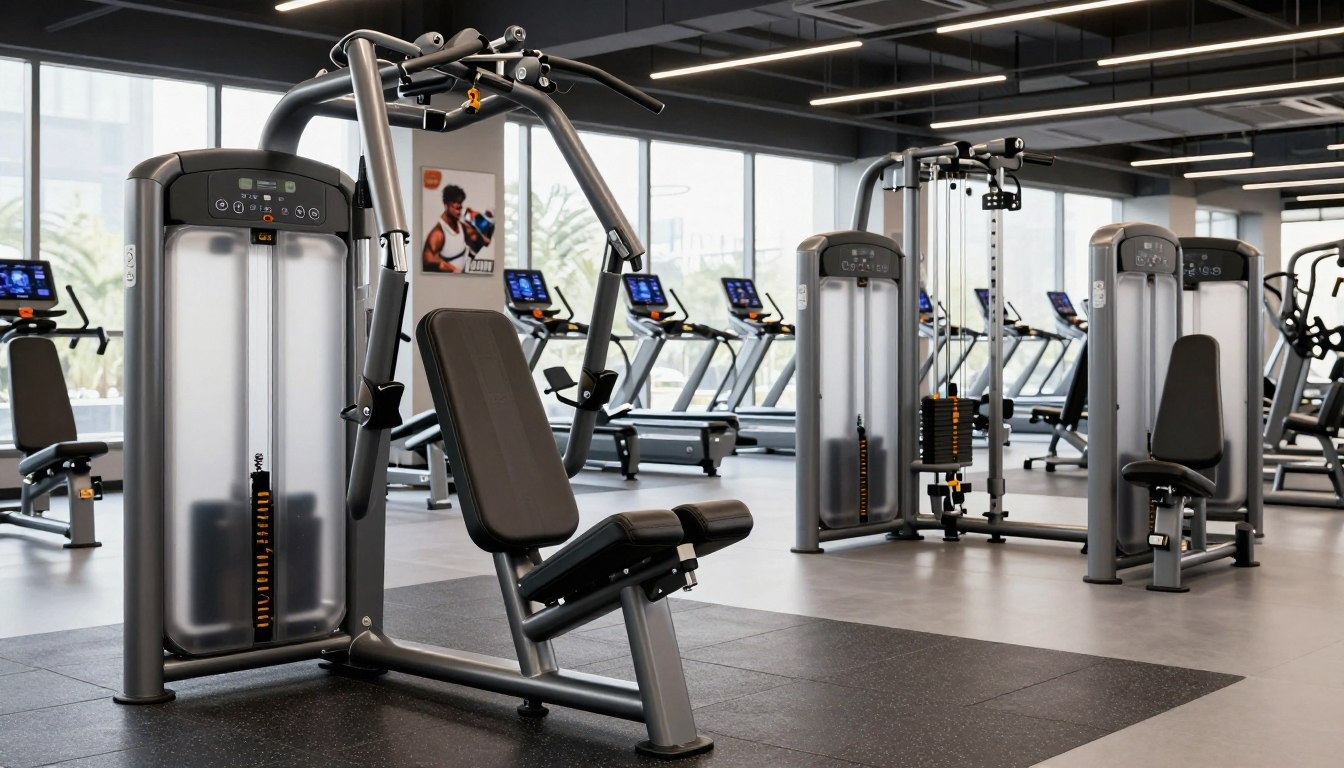
The Agony of the Plateau
You’ve seen them. Maybe you are one. They’re the gym regulars whose presence is as much a part of the landscape as the squat racks and cable machines. They show up religiously, put in the sweat, push through the burn… yet their physique seems frozen in time. Their lifts have barely budged in months. Their reflection whispers a frustrating, unanswerable question: “Why am I not growing?”
This story is heartbreakingly common. The pursuit of muscle growth—hypertrophy—isn’t just about effort. It’s a precise biological negotiation.Gym You provide a strategic stimulus (training), sufficient raw materials (nutrition), and ample time for repair (recovery), and in return, your body reluctantly adds a tiny bit of new contractile tissue. It’s a costly adaptation for your body, and it will avoid it at all costs if it can.Gym
The truth is, most people who are “stuck” are unknowingly committing a series of subtle, systemic errors. These aren’t lazy mistakes; they’re often borne of misinformation, ingrained habits, or the seductive allure of “hard work” without smart work. This article isn’t about shaming effort. It’s about redirecting it. We’re going to dissect the most pervasive gym workout mistakes that act like a handbrake on your muscle growth, explain the why behind each, and provide the clear, actionable fixes to get you moving forward again.Gym
Part 1: The Foundation Flaws – Errors in Programming & Philosophy
Before we even look at your squat form, we need to examine the blueprint. A flawed plan guarantees a flawed outcome.Gym
Mistake #1: The “Bro Split” Rut: Training Muscles Too Infrequently
The Scene: Monday is International Chest Day. You annihilate your pecs with 20 sets. You’re so sore you can’t raise your arms for three days.Gym You train shoulders on Wednesday, legs on Friday, and maybe hit chest again next Monday. This is the classic “Bro Split.”
The Science & The Sabotage: Muscle protein synthesis (MPS)—the process of building new muscle—is elevated for roughly 24-48 hours after a training stimulus. After that, it returns to baseline. If you’re only stimulating a muscle group once every 7 days, you’re getting 48 hours of building and 5 days of nothing. You’re essentially hitting the “growth button” once a week and hoping it sticks. Furthermore, the extreme soreness (DOMS) isn’t a badge of honor; it’s often a sign of excessive damage that hampers your ability to train effectively later in the week.Gym
The Fix: Increase Frequency. Shift to an Upper/Lower Split (e.g., Upper Monday, Lower Tuesday, Rest, Upper Thursday, Lower Friday) or a Push/Pull/Legs (PPL) split. This allows you to train each major muscle group 2-3 times per week with higher quality volume. You’ll stimulate MPS more often, leading to more net growth over time. The volume per session is lower, but the weekly volume is higher and more sustainable.Gym
Mistake #2: Prioritizing Weight Over Everything: Ego Lifting
The Scene: The guy loading four plates on the bar for a squat that travels three inches. The person using momentum to heave a dumbbell far too heavy for a controlled bicep curl.Gym
The Science & The Sabotage: Muscle growth occurs under mechanical tension—the force generated within the muscle itself. When you use momentum, cheat reps, or partial ranges of motion to move a weight, you offload that tension from the target muscle onto joints, tendons, and other muscle groups. The weight moves, but the muscle you’re trying to grow isn’t doing the lion’s share of the work. You’re training your ego and your nervous system’s ability to recruit help, not creating an effective growth stimulus.
The Fix: Master the Mind-Muscle Connection and Tempo. Choose a weight that allows you to perform each rep with strict, controlled form through a full range of motion. A powerful tool is to implement a deliberate tempo. Try a 3-1-2-0 cadence: 3 seconds on the lowering (eccentric) phase, a 1-second pause, a 2-second concentric (lifting) phase, and no pause at the top. This removes momentum and forces the muscle to bear tension for longer—a key driver of hypertrophy. As renowned strength coach Charles Poliquin often emphasized, “Time under tension is a critical variable for hypertrophy.”
Mistake #3: The Random Walk of Pain: No Progressive Overload
The Scene: You’ve been bench pressing 185 lbs for 3 sets of 10 for the last six months. You’re comfortable. It’s challenging, but you never push for 11 reps or try 190.Gym
The Science & The Sabotage: Progressive Overload is the non-negotiable, fundamental law of muscle adaptation. Your body will only build new muscle if it is consistently forced to handle a challenge greater than what it is accustomed to. No increase in stimulus = no need for adaptation = no growth. Doing the same workout with the same weights forever is maintenance at best.Gym
The Fix: Systematically Track and Progress. Your workout log is your most important piece of equipment. Progress doesn’t always mean adding 5 lbs. It’s a staircase with many steps:Gym
- Add one more rep to one or more sets.
- Add one more set to the exercise.
- Reduce your rest time between sets (increasing density).
- Improve your rep quality (cleaner form, slower tempo).
- Finally, add the smallest increment of weight possible (2.5 lbs plates are a lifter’s best friend).Gym
Aim to progress in some measurable way every 1-2 weeks for a given exercise.
Part 2: The Execution Errors – What You’re Doing Wrong During the Set
Even with a good plan, how you perform each rep can make or break your results.
Mistake #4: Treating Every Rep Like a 1RM: Constant Maximum Effort
The Scene: Grunting, straining, and turning purple on every single set, from your first warm-up to your last working set.Gym
The Science & The Sabotage: Training to absolute failure—the point where you cannot complete another rep—is incredibly taxing on your central nervous system (CNS) and recovery capacity. Doing this on every set leads to rapid fatigue, degraded form in subsequent exercises, and an inability to complete your planned workout volume with quality. A 2016 meta-analysis in the Journal of Sports Sciences suggested that taking sets to 1-3 reps in reserve (RIR) is just as effective for growth as training to absolute failure, but with significantly less systemic fatigue.
The Fix: Embrace RIR (Reps in Reserve). On your working sets, stop when you feel you could have done 1-3 more reps with good form. For example, if your plan calls for 3 sets of 10, choose a weight where rep 10 is tough, but you’re confident you could have grinded out rep 11. This allows you to maintain higher performance across all your sets, accumulate more total high-quality volume, and recover faster.
Mistake #5: Ignoring the Eccentric: The Controlled Drop
The Scene: The bench press that looks like a falling piano on the way down. The quick, gravity-assisted drop at the bottom of a pull-up.Gym
The Science & The Sabotage: The lowering (eccentric) phase of a lift is where you can handle the most weight and is uniquely potent for muscle damage—a key trigger for growth. When you relinquish control, you’re throwing away up to half of the growth stimulus of the rep. You’re also putting your joints under sudden, risky strain.
The Fix: Control the Descent. Make the eccentric phase a deliberate, strength-building part of the lift. Count 2-3 seconds as you lower the weight. Feel the stretch and tension in the target muscle. Not only is this safer, but the increased time under tension and greater micro-damage will send a stronger growth signal.Gym
Mistake #6: Partial Reps, Partial Gains: Shortening the Range of Motion (ROM)
The Scene: Quarter squats, half-range bench presses, and curls that never fully extend the elbow.Gym
The Science & The Sabotage: Consistently training in a shortened ROM teaches your muscles to be strong only in that partial range. It neglects crucial muscle fibers at the extended and contracted positions. Full ROM builds more complete, functional, and aesthetically balanced muscle. It also places healthier, more distributed stress on joints.
The Fix: Train Through a Full, Pain-Free ROM. For a squat, aim for at least parallel (hip crease below knee). For a bench press, touch the bar to your chest (unless limited by mobility or injury). For a row, achieve a full stretch at the start and a strong contraction at the finish. A full ROM means more total muscle fiber recruitment per rep.Gym
Part 3: The Support System Failures – Neglect Outside the Gym
You can have perfect workouts, but if the other 23 hours of your day are a mess, growth grinds to a halt.
Mistake #7: The “See-Food” Diet: Inadequate Protein & Calories
The Scene: Training hard but eating sporadically, relying on protein bars, or simply not consuming enough total food.Gym
The Science & The Sabotage: Think of training as the blueprint for muscle growth and nutrition as the building materials. If you’re in a chronic calorie deficit, your body lacks the energy and raw substrates to construct new tissue. Even if calories are sufficient, protein is the essential brick. Research consistently shows that for individuals engaged in resistance training, an intake of 1.6 to 2.2 grams of protein per kilogram of body weight (0.7 to 1 gram per pound) is optimal for maximizing muscle protein synthesis.
The Fix: Track (At Least for a While) and Prioritize Protein. You don’t need to be a lifelong calorie counter, but tracking your food for a 2-week period can be an eye-opening audit. Ensure you’re eating at maintenance calories or a slight surplus (100-300 calories) to support growth. Structure every meal around a high-quality protein source: chicken, lean beef, fish, eggs, Greek yogurt, tofu, or a quality protein powder.Gym
Mistake #8: Glorifying Busyness Over Sleep
The Scene: Proudly surviving on 5-6 hours of sleep to cram in more work, more socializing, and more late-night TV, thinking the gym effort will outweigh it.
The Science & The Sabotage: This is the grand sabotager. During deep sleep, your body releases the majority of its growth hormone, a key driver of tissue repair and muscle growth. Sleep is when MPS is most active, and when your CNS recovers from the day’s training stress. Chronic sleep deprivation (less than 7 hours regularly) increases cortisol (a muscle-breaking hormone), decreases testosterone, impairs glucose metabolism, and utterly destroys your recovery capacity. A study in the Journal of the American Medical Association found that even partial sleep deprivation significantly reduces muscle protein synthesis signaling.
The Fix: Defend Your Sleep Like Your Gains Depend On It (They Do). Aim for 7-9 hours of quality, uninterrupted sleep per night. Establish a consistent bedtime routine: dim lights, avoid screens 60 minutes before bed, keep your room cool and dark. Consider sleep non-negotiable, as important as your workout itself.
Mistake #9: No Deloads: The Unending Grind
The Scene: Training at maximum intensity, week after week, month after month, until you’re either burned out, injured, or both.
The Science & The Sabotage: Fitness is a cycle of stress and adaptation. If you never reduce the stress, your body never gets a clear signal to fully super-compensate (grow). Accumulated fatigue from training—both physical and neural—will slowly rise, masking your true fitness and making every workout feel like a grind. This is a direct path to overtraining.
The Fix: Schedule Strategic Deloads. Every 4-8 weeks of hard training, implement a deload week. This is not a week off. It’s a week of active recovery. Reduce your training volume by 40-60% (do fewer sets), reduce intensity by ~20% (use lighter weights), or focus on different movement patterns. This allows fatigue to dissipate while maintaining movement patterns, leaving you refreshed, stronger, and ready to push new progress in the following cycle.
Conclusion: From Sabotage to Synergy
The path to consistent muscle growth is less about discovering a secret hack and more about diligently removing the obstacles that you—and the common gym culture—may have inadvertently placed in your own way.
It requires a shift from a mindset of surviving workouts to one of executing a long-term strategy. It’s about trading the instant gratification of lifting the heaviest possible weight today for the sustained satisfaction of adding five pounds to your best lift, with pristine form, every month for a year.
Stop being the person who just “works out.” Become the person who trains. That means having a plan (smart programming), executing it with precision (controlled reps, full ROM, strategic effort), and supporting it with the reverence it deserves (protein, sleep, recovery).
Audit yourself against these nine saboteurs. Be brutally honest. Which ones are you guilty of? Pick the two biggest levers—perhaps it’s your lack of progressive overload and your poor sleep—and fix them for the next six weeks. The results will speak for themselves.
The plateau is not a wall. It’s a checkpoint, asking you to refine your approach. Listen to it, correct your course, and you’ll find that the growth you’ve been chasing was only ever a few smart adjustments away.
Focus Keywords: Gym Workout Mistakes, Muscle Growth Mistakes, Workout Plateaus
SEO & Article Keywords: why am I not building muscle, workout mistakes stopping gains, hypertrophy errors, bro split problems, ego lifting, progressive overload guide, reps in reserve RIR, time under tension, full range of motion, importance of sleep for muscle growth, protein intake for building muscle, deload week benefits, mind muscle connection, proper lifting form, training frequency, workout program mistakes, recovering from gym plateau, fitness burnout, nutrition for muscle gain, CNS fatigue.